

Industrial Machinery Transport and Shipping
Machine tools, presses, gensets and plant equipment on flatbed, step deck and RGN trailers in all 48 states
Quick answer
How is industrial machinery shipped?
Industrial machinery is rigged off its foundation, lifted or skidded onto a flatbed, step deck or RGN, then blocked, chained and usually tarped. The trailer depends on height and weight: tall presses and machining centers often need a step deck or RGN to stay under height limits. Rigging at each end is a separate job, so agree who does it before booking.
Updated November 2026 by the Quickway Transports broker team (FMCSA MC# 1245224).
Machinery transport, not machinery moving
Moving a machine is two jobs. Riggers, often called machinery movers, disconnect it, take it off its foundation and load it; a carrier then hauls it between sites. Quickway arranges the haul: we book the carrier and trailer, and work with your riggers at both ends so the truck arrives when the machine is ready to load.
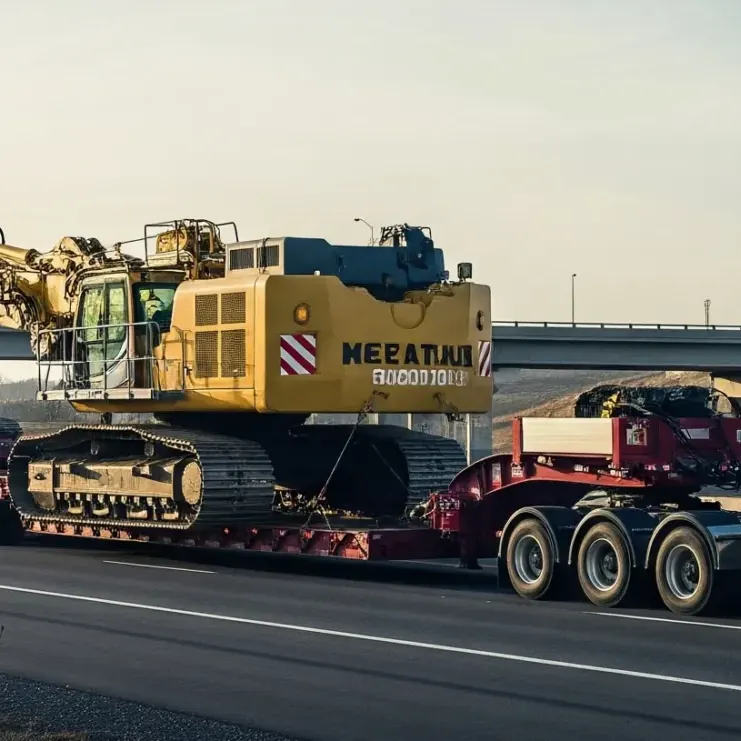
Most machine tools, presses and gensets ride on a flatbed or step deck, chosen by height: a step deck keeps machines up to about 10 ft tall at legal size. Heavy presses and large forklifts move on RGNs. Hyster's H1050XDS48 forklift, for example, is 13 ft 11 in wide and about 133,900 lbs, so it travels on a multi-axle trailer under oversize and overweight permits.
FMCSA Licensed
Broker MC# 1245224
Flatbed to RGN
Picked by height and weight
Riggers' schedule
Truck timed to the load-out
Free Quotes
Commercial shippers
Forklift and telehandler transport sizes
Forklifts, telehandlers and boom lifts are among the most common machines in plant and site moves. Sizes are from Toyota, Hyster, Kalmar, Genie and JLG.
| Machine | Transport size (L x W x H) | Transport weight | On a 2 ft RGN deck | Over legal on |
|---|---|---|---|---|
| Toyota 40-8FGU25 | 8' 8" x 3' 9" x 7' 0" | 8,000 lbs (operating) | about 10' 5" tall | none at legal size |
| Hyster H100FT | 10' 8" x 4' 9" x 7' 7" | 15,108 lbs (operating) | about 10' 11" tall | none at legal size |
| Toyota 50-8FG70U | 11' 8" x 6' 6" x 8' 1" | 20,170 lbs (operating) | about 11' 5" tall | none at legal size |
| Hyster H360XD36 | 18' 5" x 8' 4" x 12' 2" | 46,134 lbs (operating) | about 14' 2" tall | height, weight |
| Kalmar DCG330-12 | 22' 9" x 11' 3" x 14' 10" | 91,492 lbs (operating) | about 16' 10" tall | width, height, weight |
| Hyster H1050XDS48 | 25' 2" x 13' 11" x 17' 0" | 133,860 lbs (operating) | about 19' 0" tall | width, height, weight |
| Genie GTH-1056 | 22' 6" x 8' 6" x 8' 6" | 31,900 lbs (operating) | about 11' 10" tall | none at legal size |
| JLG 1055 | 20' 1" x 8' 5" x 8' 4" | 31,742 lbs (operating) | about 11' 8" tall | none at legal size |
| JLG 1850SJ | 47' 10" x 8' 2" x 9' 11" | 59,900 lbs (operating) | about 11' 11" tall | weight |
OEM figures from each maker's spec sheet, brochure or operator's manual, checked October 2026, for one standard configuration. "Over legal" compares the machine on a 2 ft RGN deck with an 8 ft 6 in width limit, a 13 ft 6 in height limit and an 80,000 lbs gross limit, assuming a tractor and trailer weighing 35,000 to 45,000 lbs.
Industrial Machinery We Arrange Transport For
CNC Machines & Machine Tools
Mills, lathes and machining centers that need level, well-blocked loads and rigging at both ends; we book the truck and time it to the riggers' schedule.
Presses & Stamping Equipment
Hydraulic and mechanical presses and forging equipment, among the heaviest plant machines, on RGN and multi-axle trailers.
Generators & Compressors
Industrial generators, gensets and air compressors on the trailer their skid weight and height call for, with any oversize permits coordinated with the carrier.
Conveyors & Material Handling
Conveyor systems, sortation lines, forklifts and telehandlers moved in sections and staged for reassembly at the new site.
Process & Plant Equipment
Tanks, mixers, reactors, packaging and printing lines moved for expansions, relocations and plant closures.
Transformers & Electrical
Transformers, switchgear and heavy electrical equipment, with the weight distribution and shock protection these dense loads need.
Industrial Machinery Transport Questions
What is industrial machinery transport?
Who rigs and loads the machine?
Can you move an entire production line or plant?
How much does machinery transport cost?
How should machinery be prepared for transport?
Sources
We last checked the figures above against these official sources in November 2026. Before each move, the carrier's permit service confirms the rules in force that day.
Get a Machinery Transport Quote
Free machinery transport quote
Tell us the machine and site details and we'll match the right trailer and rigging, handle permits, and coordinate the carrier. Free quote, all 48 states.
Keep reading
- Partial Load & LTL Flatbed →Pay for the deck space your freight uses when it does not fill a whole flatbed or step deck.
- Commercial Truck Transport →Semi trucks, dump trucks, buses and non-running units, including winch loading for dead units.
- Heavy Equipment Transport →Which trailer, permits and preparation each kind of construction, farm, mining and industrial machine needs.
- Excavator Transport →RGN and lowboy moves for excavators, and which buckets, thumbs and counterweights come off before loading.
- Bulldozer Transport →Dozer moves from compact crawlers to mining-class machines like the Cat D11, with blade and ripper removal.
- Crane Transport →Cranes moved in travel configuration or broken down into several loads, with superload permits where needed.