

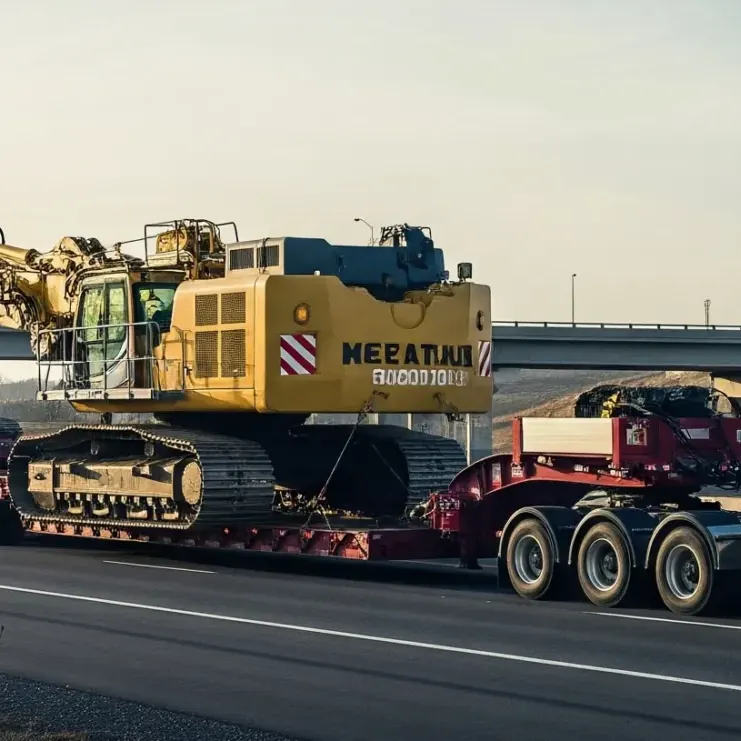
Washington Oversize & Overweight Permits for Heavy Haul
Washington permit rules, legal limits and escort triggers, and how we book heavy haul carriers for moves in and through the state.
Quick answer
Do I need a permit to move an oversize load in Washington?
Yes, once the load is over 8 ft 6 in wide or 14 ft high, or heavier than the state's axle-spacing table allows. WSDOT charges $10 for a single trip oversize permit, and overweight permits are priced per mile by the weight over legal, from 7 cents a mile. Most routine permits are self-issued in eSNOOPI Pro, and county roads need local approval.
Updated November 2026 by the Quickway Transports broker team (FMCSA MC# 1245224).
Heavy haul and oversize freight in Washington
Washington's heavy freight moves through the Puget Sound ports at Seattle and Tacoma, the aerospace and industrial plants around Everett, and the farms and orchards east of the Cascades. I-5 runs the western corridor from Vancouver to the Canadian border, I-90 crosses Snoqualmie Pass to Spokane, and I-82 and US 395 link the Tri-Cities with Oregon. We book carriers for construction machines, port cargo, farm equipment and industrial parts moving within the state or out of its ports.
Two things set the schedule here. Oversize loads on I-5, I-405, I-90 and SR 167 around Seattle and Tacoma keep weekday commuter curfews, and from November 1 to April 1 trucks over 10,000 lbs must carry chains on the mountain passes, where traction or chain signs stop permitted loads altogether. We plan around both before quoting a cross-state move.
What are the legal size and weight limits in Washington?
Under the oversize load regulations in Washington, a load above any of these limits needs a state oversize or overweight permit.
| Width | 8 ft 6 in |
|---|---|
| Height | 14 ft |
| Semitrailer length | 53 ft |
| Gross weight | 105,500 lbs |
| Single axle | 20,000 lbs |
| Tandem axle | 34,000 lbs |
Washington sets no flat 80,000 lb cap: gross weight follows the axle-spacing table in RCW 46.44.041, which tops out at 105,500 lbs on long, multi-axle rigs. A typical 5-axle tractor-trailer reaches 80,000 lbs at 51 ft between its first and last axles.
Who issues Washington oversize permits?
WSDOT's Commercial Vehicle Services office in Tumwater issues oversize and overweight permits, and most routine single trips are self-issued around the clock in eSNOOPI Pro. Self-issue works for tractor-trailers within 16 ft of width and height, 125 ft of trailer and load, and 200,000 lbs; past any of those the load is a superload that only CVS reviews. A single trip permit is good for one trip over up to 3 days on the route it names.
WSDOT permits cover state highways, including state routes through cities. County roads and city streets need approval from the local road owner, and that mileage is entered on the state permit, so the carrier's permit service lines up both before dispatch.
Permit system: eSNOOPI Pro (Electronic System Network for Oversize and Overweight Permit Information Pro)
What do Washington oversize and overweight permits cost?
- request_quote Single trip oversize (width, height or length): $10.
- request_quote Overweight: charged per mile of state highway by the weight over legal, from $0.07 a mile when the load is under 10,000 lbs over to $4.25 a mile at 100,000 lbs over, with a $14 minimum.
- request_quote More than 100,000 lbs over legal: the $4.25 rate plus $0.50 a mile for each extra 5,000 lbs or part of it.
- request_quote When a load is over size and over weight, only the overweight fee is charged.
- request_quote Superloads have no separate fee, though WSDOT can ask the applicant to share the cost of a long bridge or pavement analysis.
Worked example: 25,000 lbs over legal on a 150-mile state route
At 25,000 to 29,999 lbs over legal the rate is $0.35 a mile, so 150 miles of state highway costs 150 x $0.35 = $52.50, rounded to $53. The oversize part adds nothing, since only the overweight fee applies. County and city approvals are separate.
Washington pilot car and escort requirements
- local_police Over 11 ft wide on a two-lane highway: two certified escorts, one in front and one behind.
- local_police Over 14 ft wide on a multilane highway: one rear escort, and front and rear over 20 ft wide on undivided multilane roads.
- local_police Over 14 ft 6 in high: a front escort with a height pole on every highway.
- local_police Trailer and load over 105 ft on two-lane roads, or over 125 ft on multilane roads: one rear escort.
- local_police Front overhang over 20 ft on a two-lane highway: one front escort.
- local_police Escort drivers licensed in Washington need a WSDOT pilot/escort certificate. Superloads can need extra escorts or the State Patrol, set case by case.
What hours can oversize loads move in Washington?
- calendar_today Night travel needs no special approval while the load stays inside a 12 ft width, 14 ft 6 in height and 105 ft length. Larger loads need a permit marked for night movement, which WSDOT approves with its own hours and escort conditions.
- calendar_today Weekday commuter curfews cover listed segments around Seattle, Tacoma, Olympia, Vancouver and Spokane, mostly 6 to 9 AM and 3 to 7 PM, and all of I-405 in both directions.
- calendar_today Holidays: oversize loads stay off state highways from noon the day before Christmas, New Year's Day, Memorial Day, Independence Day and Labor Day, and from noon Wednesday through the Friday after Thanksgiving.
- calendar_today No permitted move may run when visibility is 1,000 ft or less, and loads stop where traction-advisory or chains-required signs are up on the passes.
- calendar_today Washington has no statewide weekend ban for permitted loads.
Seasonal weight limits in Washington
Washington does not run a fixed frost-law season. When freeze-thaw softens a state highway, WSDOT posts emergency or severe emergency load restrictions that cap the weight on each tire by tire size, and holding an oversize or overweight permit is no exemption. Counties post their own roads the same way, so a spring move in eastern Washington gets a fresh check of WSDOT's live truck restrictions list.
Washington Oversize Load Questions
Permits, escorts and travel rules for oversize moves in Washington.
How much does a WSDOT oversize permit cost?
When is a Washington load a superload?
Can oversize loads travel at night in Washington?
When are oversize loads banned on Washington holidays?
Do oversize loads need chains on Washington passes?
Sources
We last checked the figures above against these official sources in October 2026. Before each move, the carrier's permit service confirms the rules in force that day.
- RCW 46.44 Size, weight, load (full chapter)
- WAC 468-38 Vehicle size and weight (full chapter)
- WSDOT Commercial vehicle permits
- WSDOT Self-issue a permit (eSNOOPI Pro)
- WSDOT Permit types & fees
- WSDOT Pilot & escort vehicle (partner certifications)
- WSDOT Superloads
- WSDOT Curfew hours & holiday restrictions
- WSDOT Chain requirements for vehicles over 10,000 pounds
- WSDOT Truck restrictions (live list)
- WSDOT Form 560-002 Special Motor Vehicle Permit Regulations and Conditions (rev. 07/2023)
- WSDOT Permit Desk Guide M 3037.25 (Oct 2024)
- WSDOT Maintenance Manual M 51-01.15 Appendix B Emergency Restrictions for Roads (Dec 2025)
Get a Quote
Heavy Haul Solutions for Oversized and Specialized Loads
Near Washington: states and services
- Heavy Haul in Oregon →Oversize moves in and through Oregon: Portland, Salem, Eugene and the OR permit rules.
- Heavy Haul in Idaho →Oversize moves in and through Idaho: Boise, Meridian, Nampa and the ID permit rules.
- Heavy Haul in California →Oversize moves in and through California: Los Angeles, San Francisco, Sacramento and the CA permit rules.
- Heavy Haul in Montana →Oversize moves in and through Montana: Billings, Missoula, Great Falls and the MT permit rules.
- Heavy Equipment Transport →Which trailer, permits and preparation each kind of construction, farm, mining and industrial machine needs.
- Heavy Haul Trucking →Oversize and overweight loads on RGN, step-deck and flatbed trailers, with permits, pilot cars and route surveys arranged.