

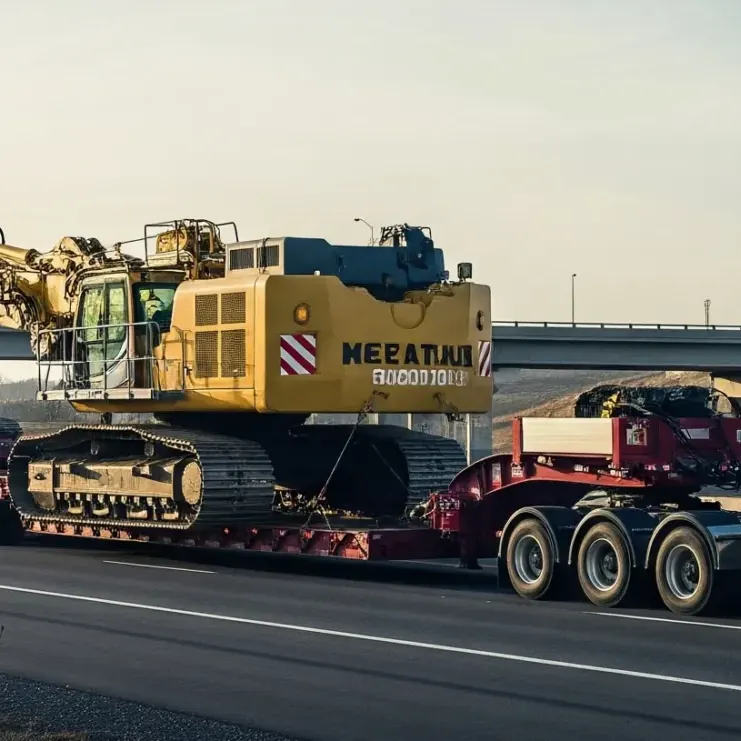
Wisconsin Oversize & Overweight Permits for Heavy Haul
Wisconsin permit rules, legal limits and escort triggers, and how we book heavy haul carriers for moves in and through the state.
Quick answer
Do I need a permit to move an oversize load in Wisconsin?
Yes, once the load is wider than 8 ft 6 in, taller than 13 ft 6 in or heavier than 80,000 lbs gross, and Wisconsin allows no scale tolerance on that weight. WisDOT issues single trip permits online: $20 for overwidth or overheight, $25 for both, and $20 to $85 for overweight up to 150,000 lbs. Local roads need the county or town's own permit.
Updated November 2026 by the Quickway Transports broker team (FMCSA MC# 1245224).
Heavy haul and oversize freight in Wisconsin
Wisconsin's heavy freight runs between Milwaukee's machine shops, the paper mills of the Fox Valley and dairy country, and much of it is headed to or from Chicago and the Twin Cities. I-94 links Milwaukee, Madison and Eau Claire, I-41 and I-43 run north to Green Bay, and I-39/90 carries traffic down to the Illinois line. We book carriers for factory equipment, farm machinery and construction machines moving inside the state or across it.
Timing shapes a Wisconsin quote more than distance. Loads over 12 ft wide pause from Saturday noon to Sunday sunrise and for holiday periods that include both gun deer season weekends in November, and oversize loads keep off the Milwaukee County Expressway at rush hour. In spring, overweight machines must avoid about 1,400 miles of Class II state highway while the frost comes out, so we check the route against the current restrictions before pricing.
What are the legal size and weight limits in Wisconsin?
Under the oversize load regulations in Wisconsin, a load above any of these limits needs a state oversize or overweight permit.
| Width | 8 ft 6 in |
|---|---|
| Height | 13 ft 6 in |
| Semitrailer length | 53 ft |
| Gross weight | 80,000 lbs |
| Single axle | 20,000 lbs |
| Tandem axle | 34,000 lbs |
Limits are set by Wis. Stat. 348.05 to 348.15, with no enforcement tolerance on weight. County and town roads designated Class B allow only 60% of these axle and gross weights.
Who issues Wisconsin oversize permits?
WisDOT's Oversize-Overweight Permit Unit in Madison issues single trip permits through its online system, where most applications are analyzed and approved automatically. A single trip permit is good for 5 days on the route it names, a return trip on the same route costs nothing extra when it is requested with the application, and the permit can be ordered as much as 5 days before the move.
The state permit covers only State, US and Interstate highways. A pickup at a farm, quarry or plant on a county or town road needs a permit from that road's maintaining authority, such as the county highway commissioner, and the carrier's permit service files both.
Permit system: WisDOT Oversize/Overweight online permit system (wi.gotpermits.com, self-issue and renewal)
What do Wisconsin oversize and overweight permits cost?
- request_quote Single trip, oversize only: $15 for overlength, $20 for overwidth or overheight, $25 for both.
- request_quote Overweight, including any oversize: $20 up to 90,000 lbs and $35 up to 100,000 lbs, then $10 more for each further 10,000 lbs, reaching $85 for 140,001 to 150,000 lbs.
- request_quote Over 150,000 lbs: $85 plus $10 for every 10,000 lbs or part of it, and a WisDOT bridge review billed at $10 per employee-hour.
- request_quote Over 16 ft wide: a $10 route review for each WisDOT region the trip crosses.
- request_quote Wisconsin charges no ton-mile or separate superload fee. State Patrol escort time is billed to the carrier, including escorts cancelled late.
Worked example: a 172,000 lb lowboy load across Wisconsin
The gross is 22,000 lbs over 150,000, which counts as three 10,000 lb steps, so the permit is $85 + 3 x $10 = $115. WisDOT adds its bridge review at $10 per employee-hour, and if the load is also over 16 ft wide, $10 for each region on the route.
Wisconsin pilot car and escort requirements
- local_police Up to 12 ft wide: no escort unless the load is over 140 ft long.
- local_police Over 12 ft to 15 ft wide: no escort up to 110 ft long, one private escort from 110 to 160 ft.
- local_police Over 15 ft to 18 ft wide: one private escort, or two when the load is over 110 ft long. Above 16 ft wide the load also needs a special permit condition to use the Interstate.
- local_police Over 18 ft to 20 ft wide: a private escort plus a law enforcement escort. Over 20 ft wide: two of each.
- local_police Over 16 ft high: a pole vehicle, counted within the maximum of two private escorts.
- local_police Over 350,000 lbs gross: one law enforcement escort. State Patrol escorts are requested by email to the post where the move starts, at least 48 hours ahead.
What hours can oversize loads move in Wisconsin?
- calendar_today Wider than 12 ft, taller than 13 ft 6 in or longer than 150 ft: daylight only, with no travel from noon Saturday to sunrise Sunday or from 4 to 8 PM on Sunday.
- calendar_today Smaller oversize loads can run at night in 67 of Wisconsin's 72 counties unless the permit says otherwise.
- calendar_today In Columbia, Dane, Milwaukee, Rock and Waukesha counties, every oversize load parks from 4 to 8 PM on Sundays, on Fridays between the fourth Friday in May and Labor Day, and on holidays and the day before.
- calendar_today Milwaukee County Expressway: no oversize travel 6 to 9 AM on weekdays, 3 to 6 PM Monday to Thursday, or 3 to 8 PM on Friday and Sunday, and no access at all over 14 ft wide, 14 ft 6 in high or 150 ft long.
- calendar_today Holidays: larger loads stop from noon on the eve of each restricted holiday to sunrise the following day, and WisDOT counts Easter weekend and both gun deer season weekends among them. Overweight loads of legal size may travel at any hour.
Seasonal weight limits in Wisconsin
Wisconsin runs spring weight restrictions by zone. When the thaw reaches 6 in below the pavement, WisDOT closes about 1,400 miles of Class II state highway to non-divisible overweight permits, and roughly 170 miles are posted at 6 tons per axle, 10 tons per tandem and 24 tons gross. The season averages early March to early May, no single trip permit overrides it, and counties and towns post their own roads.
Wisconsin Oversize Load Questions
Permits, escorts and travel rules for oversize moves in Wisconsin.
How much is a Wisconsin oversize permit?
Can oversize loads travel at night in Wisconsin?
When does a Wisconsin load need an escort?
What are Class II roads in Wisconsin?
Does a WisDOT permit cover county and town roads?
Sources
We last checked the figures above against these official sources in October 2026. Before each move, the carrier's permit service confirms the rules in force that day.
- WisDOT Oversize-Overweight Permits general page (contacts, links, bridge lists)
- WisDOT: Determine if a permit is required (legal dimensions and weights)
- WisDOT: Single trip permit information
- WisDOT: Hours of operation for permitted vehicles
- WisDOT MV2600 Single Trip Permit Information and fees (6/2021)
- WisDOT MV2605 Single Trip Permit General Conditions (7/2024)
- WisDOT Minimum Standards for Escort Vehicles chart (7/9/2018)
- Wisconsin State Patrol Permit Support Request (updated Sept 18, 2025)
- WisDOT 2026 Holiday Hours and Days of Operation for Oversize Vehicles (10/30/2025)
- WisDOT Seasonal weight restrictions page
- WisDOT Class II roads page
- Wis. Stat. ch. 348 (Vehicles: size, weight and load), published 10-1-2026
- Wis. Admin. Code ch. Trans 254 (single trip permits)
Get a Quote
Heavy Haul Solutions for Oversized and Specialized Loads
Near Wisconsin: states and services
- Heavy Haul in Illinois →Oversize moves in and through Illinois: Chicago, Aurora, Rockford and the IL permit rules.
- Heavy Haul in Michigan →Oversize moves in and through Michigan: Detroit, Grand Rapids, Lansing and the MI permit rules.
- Heavy Haul in Minnesota →Oversize moves in and through Minnesota: Minneapolis, St. Paul, Rochester and the MN permit rules.
- Heavy Haul in Ohio →Oversize moves in and through Ohio: Columbus, Cleveland, Cincinnati and the OH permit rules.
- Heavy Equipment Transport →Which trailer, permits and preparation each kind of construction, farm, mining and industrial machine needs.
- Heavy Haul Trucking →Oversize and overweight loads on RGN, step-deck and flatbed trailers, with permits, pilot cars and route surveys arranged.