

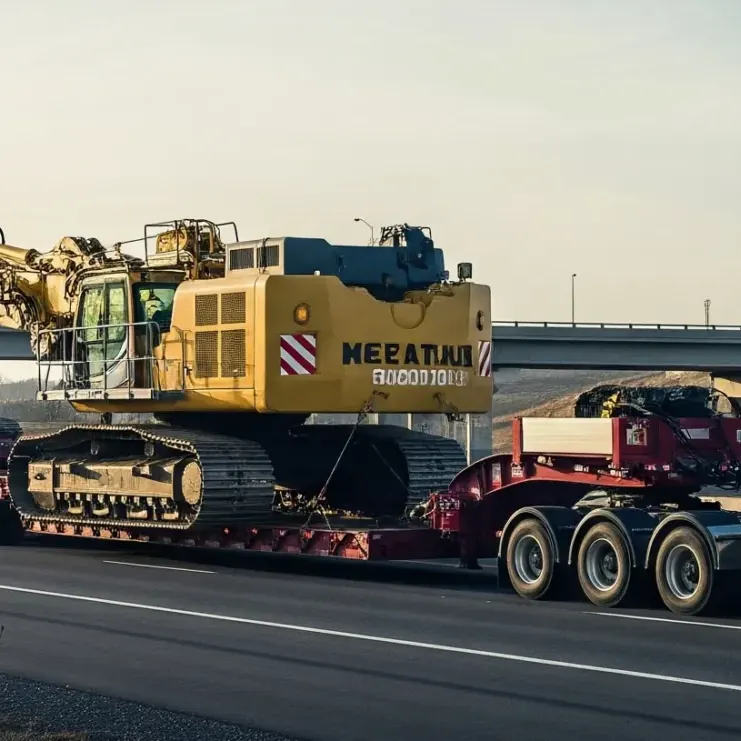
Colorado Oversize & Overweight Permits for Heavy Haul
Colorado permit rules, legal limits and escort triggers, and how we book heavy haul carriers for moves in and through the state.
Quick answer
Do I need a permit to move an oversize load in Colorado?
Yes, once the load is over 8 ft 6 in wide, 14 ft 6 in high or 80,000 lbs on the Interstate. CDOT issues permits through COOPR: a single trip oversize permit is $30, and an overweight one is $30 plus $10 per axle. Colorado's legal height is a foot above the common 13 ft 6 in, but its mountain routes add rules of their own.
Updated November 2026 by the Quickway Transports broker team (FMCSA MC# 1245224).
Heavy haul and oversize freight in Colorado
Colorado's heavy freight runs on I-25 along the Front Range from Fort Collins through Denver, Colorado Springs and Pueblo, on I-70 west over the Continental Divide toward Grand Junction and east across the plains, and on I-76 toward Nebraska. Energy equipment, construction machines for Front Range projects and farm machinery from the eastern plains make up much of it. We book carriers for loads moving within Colorado or crossing it between the Plains and the Mountain West.
The mountains set the rules here. I-70 between Morrison and West Vail closes to oversize loads at winter and summer weekend peaks, the Eisenhower-Johnson tunnel stops loads over 11 ft wide for permission, and oversize movement halts wherever the chain law is in effect. Denver, Colorado Springs and Pueblo add weekday rush hours, so we plan the route and the day before quoting.
What are the legal size and weight limits in Colorado?
Under the oversize load regulations in Colorado, a load above any of these limits needs a state oversize or overweight permit.
| Width | 8 ft 6 in |
|---|---|
| Height | 14 ft 6 in |
| Semitrailer length | 57 ft 4 in |
| Gross weight | 80,000 lbs |
| Single axle | 20,000 lbs |
| Tandem axle | 36,000 lbs |
Limits are set by C.R.S. 42-4-502 to 42-4-508. Off the Interstate, Colorado allows 40,000 lbs on a tandem and up to 85,000 lbs gross under its own formula; the table shows the Interstate figures.
Who issues Colorado oversize permits?
CDOT's Office of Freight Mobility & Safety in Denver issues permits through COOPR, which takes applications around the clock and issues some permits automatically. A single trip permit covers one move of up to 5 days, can be bought as early as five days before the move, and usually turns around in about two hours.
Annual and single trip permits stop at 16 ft high, 17 ft wide and 200,000 lbs, with length caps by road type; anything larger, or heavier than 200,000 lbs, needs a Chapter 6 Special permit with CDOT engineering review. A CDOT permit covers only the state highways named on it, so city and county roads need local permission.
Permit system: Colorado Oversize Overweight Permitting and Routing (COOPR) System
What do Colorado oversize and overweight permits cost?
- request_quote Single trip oversize: $30, a $15 statutory fee doubled by Colorado's oversize and overweight surcharge.
- request_quote Single trip overweight, or oversize and overweight together: $30 plus $10 per axle.
- request_quote Chapter 6 Special, for 200,000 to 500,000 lbs or loads beyond the routine maximums: $250.
- request_quote Super Load, 500,000 lbs or more on two lanes: $800.
- request_quote Annual permits: $250 for oversize only, $400 for overweight up to 200,000 lbs. Card payments in COOPR add $4 per permit.
Worked example: a 7-axle overweight lowboy load
A single trip overweight permit is $30 plus $10 for each of the 7 axles, or $100, and paying by card in COOPR adds $4. If the load is also wide, the fee stays the same, since oversize and overweight are priced together on one permit.
Colorado pilot car and escort requirements
- local_police Every state highway has a color on CDOT's escort and restriction map, from white for the most open roads to red for the tightest, and that color sets the escorts for each width.
- local_police Over 8 ft 6 in to 11 ft wide in daylight: one front escort on blue highways, none on yellow, green or white, and a Chapter 6 Special on red.
- local_police Over 13 ft to 15 ft wide: one front escort plus a rear escort or rear flashing light on yellow highways, and no escort on white highways.
- local_police Over 17 ft wide, or over 16 ft high: a Chapter 6 Special permit with at least one front and one rear escort.
- local_police Length: a front escort over 85 ft on mountain two-lane roads or 110 ft on other two-lane roads, and a rear escort over 115 ft on four-lane highways.
- local_police Escort drivers need a Colorado certification or one Colorado accepts, such as Arizona, Minnesota, Utah or Washington.
What hours can oversize loads move in Colorado?
- calendar_today After dark: loads up to 12 ft wide run with flashing yellow lights, 12 to 14 ft also need an escort, and wider loads wait for daylight unless a Chapter 6 Special allows it.
- calendar_today Denver, 6 to 9 AM and 3 to 6 PM on weekdays, and Colorado Springs and Pueblo, 7 to 9 AM and 4 to 6 PM: every oversize load stays off the listed highways, including I-25, I-225 and I-270.
- calendar_today I-70 from Morrison to West Vail: winter and summer weekend closures, such as westbound Friday evenings and eastbound Sundays from 3 to 9 PM.
- calendar_today Holidays: no oversize travel from 6 AM to 9 PM on Memorial Day, Independence Day and Labor Day, or from noon to 9 PM on the Friday before Memorial Day and Labor Day.
- calendar_today No oversize movement anywhere the chain law is in effect; overweight-only loads up to 200,000 lbs may chain up and continue.
Seasonal weight limits in Colorado
Colorado has no frost law on state highways. Counties and cities may post lower weights on their roads, capped at 90 days in a calendar year, and CDOT can post state highways the same way. Winter is the seasonal factor: from September 1 to May 31 trucks carry chains on I-70 west of Morrison and other mountain routes, and oversize loads stop whenever the chain law is active.
Colorado Oversize Load Questions
Permits, escorts and travel rules for oversize moves in Colorado.
How much is a Colorado oversize permit?
Can oversize loads use I-70 through the mountains?
When does a Colorado load need an escort?
When is a Colorado load a Super Load?
Can oversize loads travel at night in Colorado?
Sources
We last checked the figures above against these official sources in October 2026. Before each move, the carrier's permit service confirms the rules in force that day.
- CDOT Freight Permitting Information
- CDOT Rules & Regulations (legal limits)
- CDOT Freight Resources (pilot escort information)
- COOPR permit portal
- CDOT 2026 Holiday Schedule and Travel Restrictions
- 2 CCR 601-4 Transport Permits rule (current CCR version)
- 2 CCR 601-8 Tunnels rule (eff. 06/30/2014)
- C.R.S. Title 42 (2026 OLLS edition)
- COOPR FAQ sheet
- CDOT Bridge Weight Limit Steps (2024)
- CDOT Oversize/Overweight Restriction List
- CDOT Pilot Escort and Oversize Restrictions map
- CDOT CMV Chain Law fact sheet (08/2026)
Get a Quote
Heavy Haul Solutions for Oversized and Specialized Loads
Near Colorado: states and services
- Heavy Haul in Kansas →Oversize moves in and through Kansas: Wichita, Kansas City, Topeka and the KS permit rules.
- Heavy Haul in Utah →Oversize moves in and through Utah: Salt Lake City, Ogden, Provo and the UT permit rules.
- Heavy Haul in Wyoming →Oversize moves in and through Wyoming: Cheyenne, Casper, Gillette and the WY permit rules.
- Heavy Haul in Nebraska →Oversize moves in and through Nebraska: Omaha, Lincoln, Grand Island and the NE permit rules.
- Heavy Equipment Transport →Which trailer, permits and preparation each kind of construction, farm, mining and industrial machine needs.
- Heavy Haul Trucking →Oversize and overweight loads on RGN, step-deck and flatbed trailers, with permits, pilot cars and route surveys arranged.